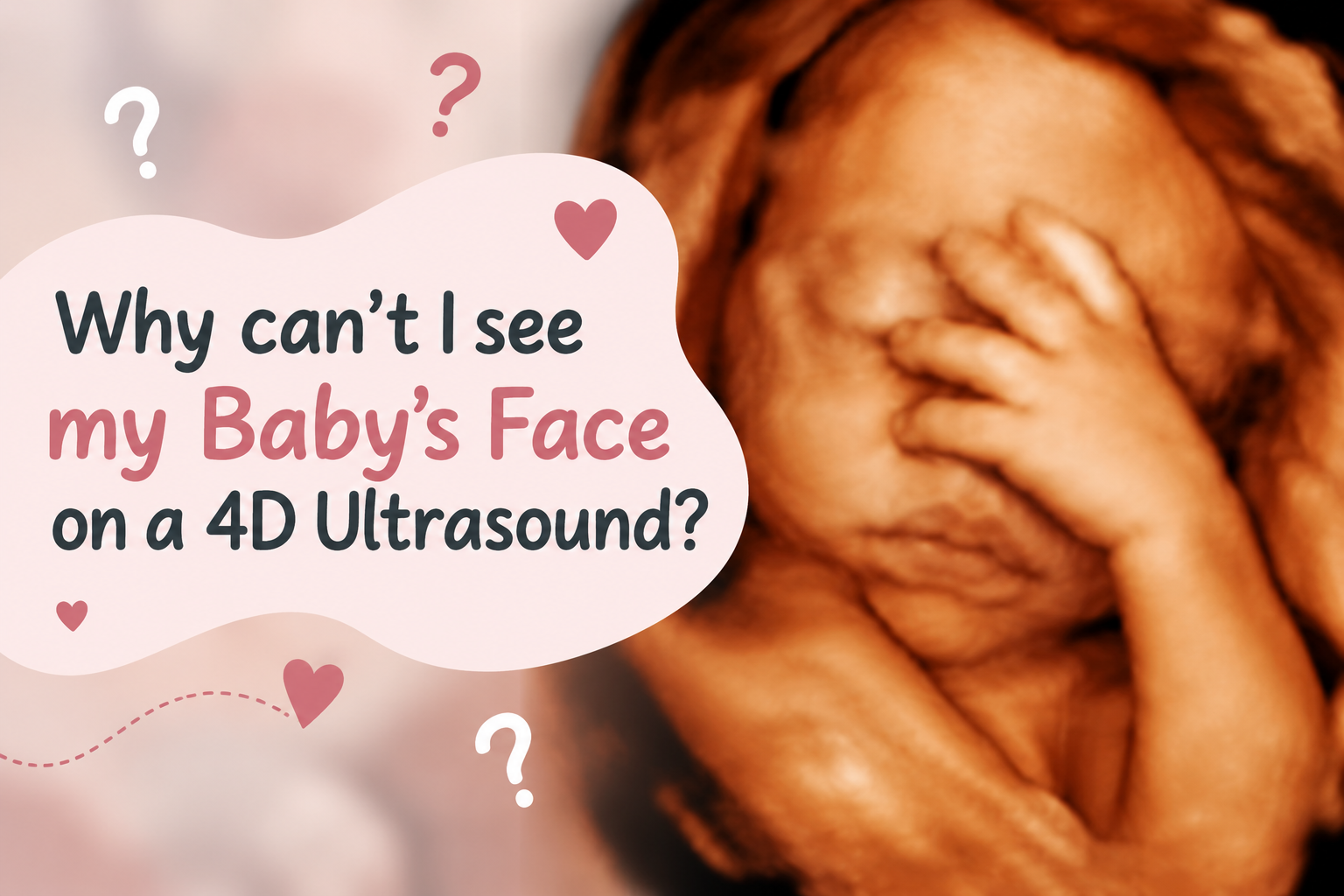
You’ve been looking forward to your 4D ultrasound, hoping to finally get a glimpse of those tiny cheeks, little nose and perhaps even a smile. Then your baby decides that today is the perfect day to hide!
If you can’t see your baby’s face on a 4D ultrasound, don’t be disappointed. It’s actually quite common for babies to hide their faces during a scan. Getting a clear 4D image depends on several factors, including your baby’s position, the position of the placenta, where their hands and feet are, and the amount of amniotic fluid around their face.
So, why is your baby hiding — and is there anything you can do about it?
Why Can’t I See My Baby’s Face on a 4D Ultrasound?
A 4D ultrasound uses sound waves to create images of your baby. Unlike an ordinary photograph, the ultrasound needs the right conditions and a reasonably clear path to produce a detailed image of your baby’s face.
For a lovely facial image, it helps to have some amniotic fluid in front of your baby’s face and as few obstructions as possible.
Unfortunately, babies don’t always cooperate with our plans!
Here are some of the most common reasons you may struggle to see your baby’s face during a 4D scan.
1. Your Baby Is Facing the Wrong Way
One of the most common reasons for not seeing your baby’s face on a 4D ultrasound is simply their position.
If your baby is facing towards your back rather than towards the ultrasound probe, there may not be a good angle from which to capture their face.
Your baby might also be curled up, facing sideways or tucked into a position that makes their face difficult to reach with the ultrasound beam.
And unfortunately, babies don’t take directions!
Sometimes a baby will turn during the appointment and suddenly give us a beautiful view. Other times, they are perfectly happy where they are.
2. Your Baby Has Their Hands or Feet in Front of Their Face
Have you ever seen ultrasound pictures of a baby with both hands covering their face?
It’s incredibly common.
Babies frequently have their hands, arms and sometimes even their feet near their faces. While this can make for some adorable moments, it can also make getting a clear 4D ultrasound image more difficult.
Ultrasound doesn’t simply see through an arm or hand to reveal the face behind it. An arm, hand or foot in front of the face can obstruct the ultrasound and create shadows in the final image.
So if your baby seems determined to play peek-a-boo, those tiny hands may be the reason!
3. Your Baby’s Face Is Against the Placenta
Another common question is:
“Can the placenta block my baby’s face on a 4D ultrasound?”
It can certainly affect the image.
If your baby’s face is very close to or pressed against the placenta, there may not be enough clear space in front of the face to produce the detailed 4D image you’re hoping for.
This can sometimes make the face appear squashed, blurry or partially hidden.
The relationship between your baby’s position, the placenta and the ultrasound probe matters more than simply whether you have an anterior or posterior placenta.
4. There Isn’t Enough Amniotic Fluid in Front of Baby’s Face
Amniotic fluid plays an important role in creating clear 3D and 4D ultrasound images.
Ideally, there should be a pocket of fluid between your baby’s face and the structures in front of it. This helps the ultrasound create a clearer surface image of your baby’s facial features.
If your baby’s face is pressed directly against the placenta or uterine wall, for example, there may be very little fluid separating them.
That can make it much harder to get that beautiful, detailed image of your baby’s nose, lips and cheeks.
5. The Umbilical Cord Is in Front of Baby’s Face
Sometimes the culprit isn’t a hand, foot or placenta — it’s the umbilical cord.
The umbilical cord may happen to lie across part of your baby’s face during your 4D ultrasound. When rendered in 3D or 4D, it can obscure part of the face or make the image look unusual.
This doesn’t necessarily mean anything is wrong. Sometimes it’s simply in an inconvenient position for getting the perfect picture.
6. Your Baby Is Getting a Little Squashed in There!
As pregnancy progresses, your baby gets bigger while the available space becomes more limited.
Later in pregnancy, your baby may be positioned lower in the pelvis or have less room to move into a position that gives us a good view of their face.
This is one reason why the timing of a 4D scan can influence the types of images we’re able to capture.
What Is the Best Time to See Baby’s Face on a 4D Ultrasound?
This is one of the most common questions parents ask when planning a 4D ultrasound in Cape Town.
There isn’t one week that guarantees perfect images. Every pregnancy and every baby is different.
As pregnancy progresses, your baby’s facial features become fuller and more defined. However, waiting too long can mean that your baby has less room to move and may settle into a position where their face is harder to see.
Your baby’s position on the actual day still plays a huge role. Even at an ideal stage of pregnancy, a baby with two hands over their face may have very different plans for their photoshoot!
If you’re unsure about when to schedule your appointment, you can contact Peek-a-Babe for advice.
Can I Get My Baby to Move During a 4D Ultrasound?
Sometimes changing your own position or moving around can encourage your baby to change position, but there is no guaranteed trick for making a baby turn around.
Your baby ultimately decides when and how they want to move.
This is part of what makes every 4D ultrasound experience unique. Sometimes you immediately get a gorgeous view of your baby’s face. Other times, a little patience is required while your baby hides behind an arm, turns away or snuggles against the placenta.
Why Does My Baby’s Face Look Weird or Distorted on a 4D Ultrasound?
This is another question that can worry parents unnecessarily.
If your baby’s 4D ultrasound face looks strange, squashed or distorted, it may simply be caused by the imaging conditions.
For example, your baby’s face may be:
- pressed against the placenta;
- pressed against the uterine wall;
- partially covered by a hand or arm;
- obscured by the umbilical cord; or
- surrounded by too little clear fluid for an ideal facial image.
Remember that a 4D ultrasound is a reconstruction created using ultrasound information — it isn’t the same as taking a photograph with a camera.
An unusual-looking 4D image therefore doesn’t automatically mean that your baby actually looks that way.
Does Not Seeing Baby’s Face Mean Something Is Wrong?
Not being able to get a clear baby face on a 4D ultrasound does not, by itself, mean there is something wrong with your baby.
There is an important difference between being unable to obtain a clear image because of baby’s position and a healthcare professional identifying a medical concern.
If you have questions about your baby’s development or health, these should always be discussed with your doctor, gynaecologist or other appropriate healthcare professional.
A 4D scan should not replace the medical scans and prenatal care recommended by your healthcare provider.
Sometimes Baby Just Doesn’t Want to Cooperate!
One of the wonderful — and occasionally frustrating — things about a 4D ultrasound is that you are seeing your baby as they are at that particular moment.
They might be stretching.
They might be sucking their thumb.
They might have their feet near their face.
Or they might decide to spend the entire appointment facing the opposite direction!
That’s part of the experience.
At Peek-a-Babe, we’ve been sharing these special moments with parents since 2006. Sometimes getting that glimpse of baby’s face takes a little patience, a different angle and some encouragement for baby to move.
Looking for a 4D Ultrasound in Cape Town?
If you’d love the opportunity to see your baby’s little face before birth, you can book a 4D scan with Peek-a-Babe in Goodwood, Cape Town.
Our clinic is located at 130 Townsend Street, Goodwood, and appointments are essential.
You can view our clinic information, address and opening times or contact Peek-a-Babe to enquire about your 4D ultrasound appointment.
And remember: if your little one decides to hide their face, don’t take it personally.
They may simply be practising their first game of peek-a-boo!
Frequently Asked Questions About Seeing Baby’s Face on a 4D Ultrasound
Why is my baby hiding their face during my 4D ultrasound?
Your baby’s position is usually an important factor. They may be facing your back, have their hands or arms over their face, be pressed against the placenta or uterine wall, or have the umbilical cord in front of their face.
Can an anterior placenta make a 4D ultrasound harder?
The position of the placenta can affect the available view, particularly when your baby’s face is very close to the placenta. However, having an anterior placenta doesn’t automatically mean you won’t get good 4D images.
Why does my baby’s nose look flat on a 4D ultrasound?
If your baby’s face is pressed against the placenta or uterine wall, or another structure is very close to the face, the rendered image can make features such as the nose look flattened or distorted. The image is not the same as an ordinary photograph.
Why does my baby’s 4D ultrasound look blurry?
Baby’s position, movement, hands or feet near the face, the placenta, umbilical cord and the amount of fluid in front of the face can all affect how clear a 4D ultrasound image appears.
What if my baby won’t show their face during the ultrasound?
Don’t panic. Babies don’t always cooperate during scans! Your baby may change position during the appointment, but there is no guaranteed way to make them turn or move their hands away from their face.
Is it normal not to see the baby’s face clearly on a 4D ultrasound?
Yes. A clear facial image depends heavily on baby’s position and the structures surrounding their face at that particular moment. Not obtaining a perfect facial picture does not by itself indicate that something is wrong.